For the folks visiting this blog from Canada and the US, have you ever wondered what 300 km/h (186 MPH) looks like on a train?
Showing posts with label day trip. Show all posts
Showing posts with label day trip. Show all posts
Sunday, August 1, 2010


Monday, July 19, 2010
Insane weekend II, part 1: Gwangju
In May, I did a crazy weekend trip out to Fukuoka and Hiroshima, Japan (1, 2, 3) and the DMZ (1) back-to-back in less than 4 days. I said to myself that I probably won't travel so insanely again until I leave Korea.
Yeah, right.
My school's classes finished on Wednesday, and I unexpectedly had Thursday off. Friday was already a day off, and I had already planned to go to Busan for the weekend with a friend. So now I have an extra day off, and my time in South Korea is limited. What did I do?
I decided to do another insane traveling weekend.
One of the places I was already considering was Gwangju (광주/光州), in the southwestern part of South Korea. Mainly, it's for historical interest; Gwangju was the site of a major political uprising and massacre during the country's period under military rule. One of the pivotal sites, the former Jeollanam provincial building, was being scheduled for demolition so it seemed a bit important to visit it now rather than later.
I woke up bright and early on Thursday morning. I live near Seoul Station, which serves most train routes going to other parts of the country, but in this particular case, the KTX bullet train to Gwangju started at Yongsan Station. I had to make an extra journey, but Yongsan isn't too far away. The trip to Gwangju takes a bit longer than usual because after Daejeon, the high-speed rails stop and the train goes at regular speed. After what felt like forever, I arrived at Gwangju Station.

Gwangju Station in all its glory.
Unlike some of the other KTX terminal stations, Gwangju Station is not connected to the subway system. I had to go on foot for a while to reach one, but in my stupidity during the planning phase, I didn't realize that there's another KTX station in Gwangju that DOES connect the subway. Whoops.
The Gwangju Subway has an interesting payment system. In Seoul, we have T-Money cards, which are contact-less smart cards that you use. One-time only tickets in Seoul work exactly like the cards, except you return them to a machine at the end to get your 500 KRW (50 cents CAD) card deposit back. Gwangju's system gives you a small POG-like token. It has a sensor inside, which you scan like a smart card. When you exit, you don't scan it. Instead, you insert the token in a slot, and the ticket machine swallows up the token and lets you out.


Views of a Gwangju Subway car. It's narrower and feels more cramped than Seoul's subway cars, but are a lot fancier.
My first stop was the former Jeollanam provincial offices. This building was the site of a lot of bloodshed and violence during South Korea's period under military rule; these uprisings eventually led to the democratization of South Korea, which is a source of pride among residents of Gwangju. One of the people involved in the uprisings was Kim Dae-Jung, who eventually became one of the most influential presidents of South Korea and unfortunately passed away on the day I arrived at Incheon airport last year. (Canadians: he was like the Koreans' version of Pierre Trudeau, except more activist-like.)

The former Jeollanam provincial offices, site of much bloodshed and violence during the Gwangju democratization uprisings in 1980.
When Gwangju became a self-governing metropolitan city, the capital of Jeollanam province (which Gwangju used to be a part of) moved out and the building was vacated. In the photo above, you can see demolition fences around the building, and much of the area looks like a construction zone at the moment. The fate of the building is uncertain, but in any case, my timing was impeccable.
After having lunch nearby, I went out to the 518 Memorial Park, which is dedicated to the victims and heroes of the uprisings (nicknamed "518" because of the uprising's starting date, hence the name of the park).

The 518 Memorial Park.
Afterwards, I decided to check out the World Cup Stadium. Officially named Guus Hiddink Stadium, it was one of the important venues of the 2002 FIFA World Cup in Korea. It was named after the Dutch-born head coach of the South Korean team during that tournament. It was a bit far, and I decided to catch a taxi back rather than waste more time.

Gwangju World Cup Stadium, or Guus Hiddink Stadium.
Near Gwangju Station is another important site of the Gwangju uprisings, Chonnam National University. It was at this university that the uprisings started in the first place, and it shows. Throughout the university are structures dedicated to the uprisings as well as reminders of how democracy is something worth fighting for in the face of injustice.

Path near the entrance to Chonnam National University.

A plaque commemorating the university's role in the Gwangju uprisings.


A statue dedicated to the Gwangju uprisings.
After seeing the university, I headed back to Gwangju Station and started making my way home on the KTX... and got ready to head off across South Korea again the very next day, this time to Busan for two days.
---
Coming next:
Yeah, right.
My school's classes finished on Wednesday, and I unexpectedly had Thursday off. Friday was already a day off, and I had already planned to go to Busan for the weekend with a friend. So now I have an extra day off, and my time in South Korea is limited. What did I do?
I decided to do another insane traveling weekend.
One of the places I was already considering was Gwangju (광주/光州), in the southwestern part of South Korea. Mainly, it's for historical interest; Gwangju was the site of a major political uprising and massacre during the country's period under military rule. One of the pivotal sites, the former Jeollanam provincial building, was being scheduled for demolition so it seemed a bit important to visit it now rather than later.
I woke up bright and early on Thursday morning. I live near Seoul Station, which serves most train routes going to other parts of the country, but in this particular case, the KTX bullet train to Gwangju started at Yongsan Station. I had to make an extra journey, but Yongsan isn't too far away. The trip to Gwangju takes a bit longer than usual because after Daejeon, the high-speed rails stop and the train goes at regular speed. After what felt like forever, I arrived at Gwangju Station.

Gwangju Station in all its glory.
Unlike some of the other KTX terminal stations, Gwangju Station is not connected to the subway system. I had to go on foot for a while to reach one, but in my stupidity during the planning phase, I didn't realize that there's another KTX station in Gwangju that DOES connect the subway. Whoops.
The Gwangju Subway has an interesting payment system. In Seoul, we have T-Money cards, which are contact-less smart cards that you use. One-time only tickets in Seoul work exactly like the cards, except you return them to a machine at the end to get your 500 KRW (50 cents CAD) card deposit back. Gwangju's system gives you a small POG-like token. It has a sensor inside, which you scan like a smart card. When you exit, you don't scan it. Instead, you insert the token in a slot, and the ticket machine swallows up the token and lets you out.


Views of a Gwangju Subway car. It's narrower and feels more cramped than Seoul's subway cars, but are a lot fancier.
My first stop was the former Jeollanam provincial offices. This building was the site of a lot of bloodshed and violence during South Korea's period under military rule; these uprisings eventually led to the democratization of South Korea, which is a source of pride among residents of Gwangju. One of the people involved in the uprisings was Kim Dae-Jung, who eventually became one of the most influential presidents of South Korea and unfortunately passed away on the day I arrived at Incheon airport last year. (Canadians: he was like the Koreans' version of Pierre Trudeau, except more activist-like.)

The former Jeollanam provincial offices, site of much bloodshed and violence during the Gwangju democratization uprisings in 1980.
When Gwangju became a self-governing metropolitan city, the capital of Jeollanam province (which Gwangju used to be a part of) moved out and the building was vacated. In the photo above, you can see demolition fences around the building, and much of the area looks like a construction zone at the moment. The fate of the building is uncertain, but in any case, my timing was impeccable.
After having lunch nearby, I went out to the 518 Memorial Park, which is dedicated to the victims and heroes of the uprisings (nicknamed "518" because of the uprising's starting date, hence the name of the park).

The 518 Memorial Park.
Afterwards, I decided to check out the World Cup Stadium. Officially named Guus Hiddink Stadium, it was one of the important venues of the 2002 FIFA World Cup in Korea. It was named after the Dutch-born head coach of the South Korean team during that tournament. It was a bit far, and I decided to catch a taxi back rather than waste more time.

Gwangju World Cup Stadium, or Guus Hiddink Stadium.
Near Gwangju Station is another important site of the Gwangju uprisings, Chonnam National University. It was at this university that the uprisings started in the first place, and it shows. Throughout the university are structures dedicated to the uprisings as well as reminders of how democracy is something worth fighting for in the face of injustice.

Path near the entrance to Chonnam National University.

A plaque commemorating the university's role in the Gwangju uprisings.


A statue dedicated to the Gwangju uprisings.
After seeing the university, I headed back to Gwangju Station and started making my way home on the KTX... and got ready to head off across South Korea again the very next day, this time to Busan for two days.
---
Coming next:
To Busan, day 1
To Busan, day 2
Wednesday, August 19, 2009
In Korea
I waited a bit to post this because there's a lot of meat in this one -- no pun intended (you'll see what I mean later).
Well, there went the longest flight I've taken since I was a small kid. My plan to sleep during the flight didn't exactly pan out but the plane got upgraded to one with laptop plugs, so I kept myself entertained, at least. Plus, the guy sitting next to me was a Chinese student who was visiting Vancouver for an engineers' symposium at UBC, so we had quite a lot to discuss (including why Wreck Beach is so famous).
The Shanghai airport's customs system is kind of wacky. It was actually posible to leave the airport during the flight connection. It was 33 degrees Celsius plus humidity. As soon as I stepped out, I either started sweating or everything attached me started to become wet -- one of the two. In any case, I decided that 30 seconds was enough.
 Above: Shanghai's Budong Airport's terminal is large and spacious, but doesn't seem to have air conditioning, which made for a stuffy wait. That didn't stop me from conquering the place in the name of the Anaheim Ducks.
Well, there went the longest flight I've taken since I was a small kid. My plan to sleep during the flight didn't exactly pan out but the plane got upgraded to one with laptop plugs, so I kept myself entertained, at least. Plus, the guy sitting next to me was a Chinese student who was visiting Vancouver for an engineers' symposium at UBC, so we had quite a lot to discuss (including why Wreck Beach is so famous).
The Shanghai airport's customs system is kind of wacky. It was actually posible to leave the airport during the flight connection. It was 33 degrees Celsius plus humidity. As soon as I stepped out, I either started sweating or everything attached me started to become wet -- one of the two. In any case, I decided that 30 seconds was enough.
 Above: Shanghai's Budong Airport's terminal is large and spacious, but doesn't seem to have air conditioning, which made for a stuffy wait. That didn't stop me from conquering the place in the name of the Anaheim Ducks.
Another weird part about that is between being let out and going back in (I needed to clear customs twice -- once for entering the arrivals terminal and once again for getting back into the secured area as a passenger for the second leg of the journey) -- they had me under medical quarantine for a while. Apparently all the people on board our plane with connecting flights had to get our temperatures taken. They kept me longer than the others, but apparently it was due to a thermometer malfunction; it gave me a temperature reading that was so low that I should be dead by now. But it got resolved easily.
The second leg of the journey from Shanghai to Seoul was less interesting. The guy next to me was a Korean who didn't speak much English at all but his son is learning it in school and practiced some phrases with me. In return, the Korean dad helped me with nailing down the pronunciations of certain key Korean phrases like "kamsa hamnida" ("thank you") and "annyeong haseo" ("hello"). Apparently I wasn't that far off, despite learning only through text; the only problems I had involved stressing the correct syllables.
However, the most interesting part of that flight came during the landing process. You know the NASA world map of the earth's lights at night? Notice how North Korea is all dark and South Korea is all bright. Well, since Incheon and Seoul are about an hour's drive away from the border with North Korea, I got to see the difference with my own two eyes that night -- that NASA pic shows the truth. Yikes.
The customs in South Korea is, as someone I know put it so elegantly, a complete joke for a country that's still technically at war (with North Korea, obviously). There were no questions asked, and apparently that is close to the norm. The only difference is that my passport visa explains my purpose in South Korea, while other people need to be asked about that.
I spent an overnighter at Incheon International Airport (which serves Seoul). It wasn't comfortable but not uncomfortable either. It was eerily quiet. And over here, airport security must march down the hallways back and forth, in pairs always next to each other. And their dress is similar to a soldier's (there might be a reason for that), so it felt like a neverending army march while you try to sleep.
 Above: Late night at Incheon International Airport. They actually turn off a lot of lights as midnight approaches, and then like this around 3:30am. And then the lights start coming back on again.
Finally checked into the hotel this morning. It was freaking sweltering today... I knew this ahead of time, but I arrived in the middle of a little heat wave. I tried to nap but anything more than one hour proved futile, so I took the subway ride out to Seoul. Coincidentally, when my card made a weird hiccup and I asked the only white person around if they knew what the error meant (since nobody else spoke English), he happened to ask me where I'm from -- and he's from Richmond too! Small world.
Seoul traffic is insane. I thought Richmond was bad, but Richmond drivers are now angelic by comparison. Here, it doesn't matter whether the traffic light is red or green -- if the drivers don't see anyone crossing, they'll just shoot ahead. And this doesn't happen with only one driver, but almost always several at a time. In other words, multiple red light dashers in a row.
There were also more close calls in today's journey than I've seen all year in Richmond. It's amazing that so many of them don't result in accidents, but I happened to see two incidents that DID turn into accidents -- and both were hit-and-run. One of them took off while the other is left staring at the damage and trying to get witnesses (and none of the other drivers were willing to be one). It makes me feel really self-conscious about even going out on the streets. I got off at Yongsan Station (where I met the fellow Richmonder) and made it to Samgakji Station somehow, someway.
It was during that short stretch that I saw all the craziness. That was enough for me... I decided to get the heck out of dodge and get back to the hotel in Incheon, where I showered off all the sweat that came from the humidity (or maybe I was washing off the humidity itself, I don't know) and relaxed in some air conditioning for a bit while sorting photos.
(If you feel like making an offensive "Asians can't drive" joke at this point, I don't blame you. I would.)
It's been pretty humid and hot today... I landed right in a heat wave and lingering summer storm (typical Asian weather pattern in summer). Temps are in the 30s Celsius right now and it's almost 9pm. It's supposed to drop to the low 20s Celsius by the end of the week.
And tonight for dinner, I forgot how much the South Korea won is and how much you can get for it. I did something stupid and ordered 32,000 won of food, which turned out to be enough to feed a whole family. I guess that's a lesson learned -- if it's slightly less than 10,000 won, then it's more than enough. I'm so used to the small servings at home, while here they give you HUGE servings! Lesson learned... next time, spend as little as possible on food because there's a chance that they'll give you more than enough.
The bad thing about everything in terms of keeping touch with the outside world is that my cellphone doesn't work here because it's a GSM phone on prepaid, and the hotel doesn't have wifi (they only offer internet on a shared computer in the lobby). I'm writing this post at the arrivals level of the Incheon airport, where I spent the night about 24 hours ago, because they have free wifi with a very strong signal and also a power outlet nearby. The hotel's only two subway stations away from the airport (one if you don't count the airport's cargo terminal).
I'll be off to the teacher orientation tomorrow. There were some coming in today (for the non-Seoul EPIK teachers) and I had a nice chat with someone who came in from Los Angeles before I left for the hotel. Seems that for their group, they were overloaded to the point where people can't bring more than one suitcase into the dorm rooms; all other luggage was to be locked up. I didn't hear anything about this for my EPIK-Seoul orientation, but we're guaranteed to have a smaller group (since there are only 100 of us, as opposed to the huge biker gang-like group for today's group).
The second leg of the journey from Shanghai to Seoul was less interesting. The guy next to me was a Korean who didn't speak much English at all but his son is learning it in school and practiced some phrases with me. In return, the Korean dad helped me with nailing down the pronunciations of certain key Korean phrases like "kamsa hamnida" ("thank you") and "annyeong haseo" ("hello"). Apparently I wasn't that far off, despite learning only through text; the only problems I had involved stressing the correct syllables.
However, the most interesting part of that flight came during the landing process. You know the NASA world map of the earth's lights at night? Notice how North Korea is all dark and South Korea is all bright. Well, since Incheon and Seoul are about an hour's drive away from the border with North Korea, I got to see the difference with my own two eyes that night -- that NASA pic shows the truth. Yikes.
The customs in South Korea is, as someone I know put it so elegantly, a complete joke for a country that's still technically at war (with North Korea, obviously). There were no questions asked, and apparently that is close to the norm. The only difference is that my passport visa explains my purpose in South Korea, while other people need to be asked about that.
I spent an overnighter at Incheon International Airport (which serves Seoul). It wasn't comfortable but not uncomfortable either. It was eerily quiet. And over here, airport security must march down the hallways back and forth, in pairs always next to each other. And their dress is similar to a soldier's (there might be a reason for that), so it felt like a neverending army march while you try to sleep.
 Above: Late night at Incheon International Airport. They actually turn off a lot of lights as midnight approaches, and then like this around 3:30am. And then the lights start coming back on again.
Finally checked into the hotel this morning. It was freaking sweltering today... I knew this ahead of time, but I arrived in the middle of a little heat wave. I tried to nap but anything more than one hour proved futile, so I took the subway ride out to Seoul. Coincidentally, when my card made a weird hiccup and I asked the only white person around if they knew what the error meant (since nobody else spoke English), he happened to ask me where I'm from -- and he's from Richmond too! Small world.
Seoul traffic is insane. I thought Richmond was bad, but Richmond drivers are now angelic by comparison. Here, it doesn't matter whether the traffic light is red or green -- if the drivers don't see anyone crossing, they'll just shoot ahead. And this doesn't happen with only one driver, but almost always several at a time. In other words, multiple red light dashers in a row.
There were also more close calls in today's journey than I've seen all year in Richmond. It's amazing that so many of them don't result in accidents, but I happened to see two incidents that DID turn into accidents -- and both were hit-and-run. One of them took off while the other is left staring at the damage and trying to get witnesses (and none of the other drivers were willing to be one). It makes me feel really self-conscious about even going out on the streets. I got off at Yongsan Station (where I met the fellow Richmonder) and made it to Samgakji Station somehow, someway.
It was during that short stretch that I saw all the craziness. That was enough for me... I decided to get the heck out of dodge and get back to the hotel in Incheon, where I showered off all the sweat that came from the humidity (or maybe I was washing off the humidity itself, I don't know) and relaxed in some air conditioning for a bit while sorting photos.
(If you feel like making an offensive "Asians can't drive" joke at this point, I don't blame you. I would.)
It's been pretty humid and hot today... I landed right in a heat wave and lingering summer storm (typical Asian weather pattern in summer). Temps are in the 30s Celsius right now and it's almost 9pm. It's supposed to drop to the low 20s Celsius by the end of the week.
And tonight for dinner, I forgot how much the South Korea won is and how much you can get for it. I did something stupid and ordered 32,000 won of food, which turned out to be enough to feed a whole family. I guess that's a lesson learned -- if it's slightly less than 10,000 won, then it's more than enough. I'm so used to the small servings at home, while here they give you HUGE servings! Lesson learned... next time, spend as little as possible on food because there's a chance that they'll give you more than enough.
The bad thing about everything in terms of keeping touch with the outside world is that my cellphone doesn't work here because it's a GSM phone on prepaid, and the hotel doesn't have wifi (they only offer internet on a shared computer in the lobby). I'm writing this post at the arrivals level of the Incheon airport, where I spent the night about 24 hours ago, because they have free wifi with a very strong signal and also a power outlet nearby. The hotel's only two subway stations away from the airport (one if you don't count the airport's cargo terminal).
I'll be off to the teacher orientation tomorrow. There were some coming in today (for the non-Seoul EPIK teachers) and I had a nice chat with someone who came in from Los Angeles before I left for the hotel. Seems that for their group, they were overloaded to the point where people can't bring more than one suitcase into the dorm rooms; all other luggage was to be locked up. I didn't hear anything about this for my EPIK-Seoul orientation, but we're guaranteed to have a smaller group (since there are only 100 of us, as opposed to the huge biker gang-like group for today's group).
Monday, June 29, 2009
Victoria trip
I took a little day trip to Victoria earlier this week. Besides the really scary-looking weather (more on that later), it wasn't the notable trip that it usually is, unfortunately. Usually, I'm your stereotypical Victoria tourist, hanging out at all the tourist traps along the Inner Harbour. But this time, I avoided that and decided to check out the places that tourists usually don't go for (but weirdos like me do).
While the date was planned fairly ahead of time, the weather wasn't cooperating. This area of Canada is usually warm, dry and sunny for most of the summer (as opposed to cold, damp and rainy for the winter), but it looked like it was about to pour a new one on me as I was on the bus towards the ferry terminal in Tsawwassen. It was raining pretty significantly on the freeway and was raining slightly by the time I got the terminal.
The way there was just insane. The wind was probably the strongest I've ever experienced on the route, but it made for some good sunshine. So much for the rain... right?
 Above: Sunny skies above the Strait of Georgia... But will it last?
Well, the weather decided to scare me one more time. As we arrived, the whole place looked dark due to heavy clouds. It seriously looked like it was going to be a tempest. Along the highway from Swartz Bay towards Victoria, it started raining (again) and I was honestly wondering if picking that date wasn't a mistake.
 Above: The British Columbia legislative buildings (similar to a state capitol) in Victoria, the capital city of the province of British Columbia.
Luckily, the weather cleared up by the time I reached my first destination, the University of Victoria (UVic). As an amateur photographer, I tend to find university campuses great places to take photos. UVic's campus proves to be quite interesting in some ways.
The campus is centered around a road that is almost perfectly circular, and most of the campus buildings lie within that circle. It is literally impossible to get lost, if you don't cross the road.
Also, the campus is split roughly in half between two municipalities, Oak Bay and Saanich. In fact, some of the campus buildings straddle the city limits; it is possible to have your professor lecturing from the Oak Bay side of the line while you're taking notes from the Saanich side of the line.
The campus itself is pretty nice; there are some new buildings sprouting up and some of them put my alma mater's (UBC) buildings to shame. However, even the nice architecture was overshadowed by one thing. Actually, make that hundreds of things. To be more specific -- rabbits.
 Above: A lone rabbit at the University of Victoria.
There were rabbits everywhere on campus. And I mean that quite literally. I have a feeling that rabbits actually outnumber students at UVic. I've honestly never seen that many rabbits in one place before in my life. I'd hate to be swarmed by a rabbit posse after a night class.
One thing about the campus layout that's pretty good is the presence of a campus center, near the UVic Quadrangle. UBC doesn't have that; the closest we have to a campus center is the Student Union Building, which is usually too far from the students in the south end of campus. It's amazing how one realizes how big of a sprawling mess the UBC campus is when compared to other universities.
After UVic, I hit several malls in the area, including Mayfair Shopping Centre and Hillside Shopping Centre. They're your typical suburban malls, but I managed to get a pretty good deal for a new Anaheim Angels clock. However, it doesn't work properly, as I later found out at home. There's something wrong with the motor, which makes the hour and minute hands malfunction. Gotta fix that later. Oh well... It's $40 elsewhere (I got it for $10), so it doesn't feel quite as bad.
Back in downtown Victoria after those trips, I had some time to kill before heading back. So I went to Victoria's Chinatown, which is the oldest Chinatown in Canada and the second oldest after San Francisco's. In there, I stumbled across a place that I somehow missed during my previous trips to Victoria -- Fan Tan Alley.
 Above: Fan Tan Alley in Chinatown, Victoria.
Fan Tan Alley is known as being quite possibly the narrowest street in Canada. Its narrowest point measures 90 centimeters (just under 3 feet) wide. It used to be a hotbed for gambling and opium dens, but now houses tourist gift shops, some art galleries and boutiques. It's a pretty bizarre experience to find a mini-community inside a narrow alley between two old brick buildings, that's for sure.
The journey back on the ferry was quite turbulent. The waves were pretty punishing and I was feeling thankful I decided to delay dinner until I arrived on the mainland, because I would've certainly lost that dinner several times over.
Overall, it was an exhausting day (I was awake for 22 hours straight, because I needed to catch the early ferry there and ended up taking the last ferry back), but that's what trips to Victoria usually call for, in my case. Let's see how long it'll take for my body to catch up with the sleep it was begging for throughout that trip.
While the date was planned fairly ahead of time, the weather wasn't cooperating. This area of Canada is usually warm, dry and sunny for most of the summer (as opposed to cold, damp and rainy for the winter), but it looked like it was about to pour a new one on me as I was on the bus towards the ferry terminal in Tsawwassen. It was raining pretty significantly on the freeway and was raining slightly by the time I got the terminal.
The way there was just insane. The wind was probably the strongest I've ever experienced on the route, but it made for some good sunshine. So much for the rain... right?
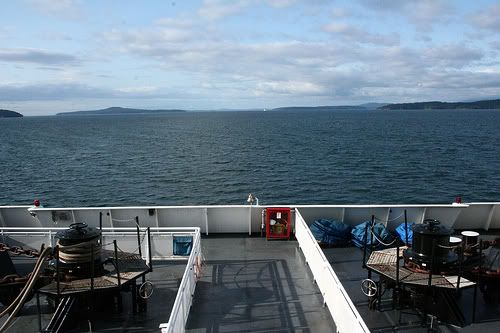 Above: Sunny skies above the Strait of Georgia... But will it last?
Well, the weather decided to scare me one more time. As we arrived, the whole place looked dark due to heavy clouds. It seriously looked like it was going to be a tempest. Along the highway from Swartz Bay towards Victoria, it started raining (again) and I was honestly wondering if picking that date wasn't a mistake.
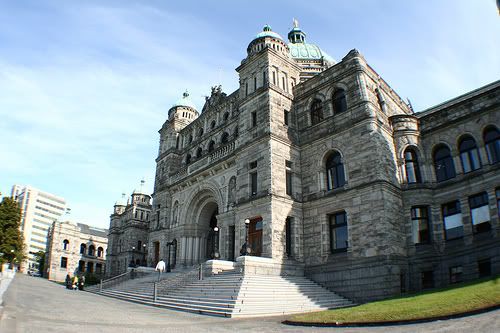 Above: The British Columbia legislative buildings (similar to a state capitol) in Victoria, the capital city of the province of British Columbia.
Luckily, the weather cleared up by the time I reached my first destination, the University of Victoria (UVic). As an amateur photographer, I tend to find university campuses great places to take photos. UVic's campus proves to be quite interesting in some ways.
The campus is centered around a road that is almost perfectly circular, and most of the campus buildings lie within that circle. It is literally impossible to get lost, if you don't cross the road.
Also, the campus is split roughly in half between two municipalities, Oak Bay and Saanich. In fact, some of the campus buildings straddle the city limits; it is possible to have your professor lecturing from the Oak Bay side of the line while you're taking notes from the Saanich side of the line.
The campus itself is pretty nice; there are some new buildings sprouting up and some of them put my alma mater's (UBC) buildings to shame. However, even the nice architecture was overshadowed by one thing. Actually, make that hundreds of things. To be more specific -- rabbits.
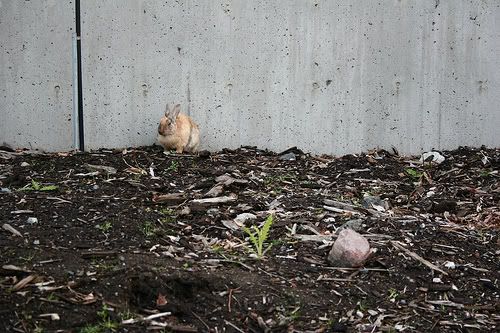 Above: A lone rabbit at the University of Victoria.
There were rabbits everywhere on campus. And I mean that quite literally. I have a feeling that rabbits actually outnumber students at UVic. I've honestly never seen that many rabbits in one place before in my life. I'd hate to be swarmed by a rabbit posse after a night class.
One thing about the campus layout that's pretty good is the presence of a campus center, near the UVic Quadrangle. UBC doesn't have that; the closest we have to a campus center is the Student Union Building, which is usually too far from the students in the south end of campus. It's amazing how one realizes how big of a sprawling mess the UBC campus is when compared to other universities.
After UVic, I hit several malls in the area, including Mayfair Shopping Centre and Hillside Shopping Centre. They're your typical suburban malls, but I managed to get a pretty good deal for a new Anaheim Angels clock. However, it doesn't work properly, as I later found out at home. There's something wrong with the motor, which makes the hour and minute hands malfunction. Gotta fix that later. Oh well... It's $40 elsewhere (I got it for $10), so it doesn't feel quite as bad.
Back in downtown Victoria after those trips, I had some time to kill before heading back. So I went to Victoria's Chinatown, which is the oldest Chinatown in Canada and the second oldest after San Francisco's. In there, I stumbled across a place that I somehow missed during my previous trips to Victoria -- Fan Tan Alley.
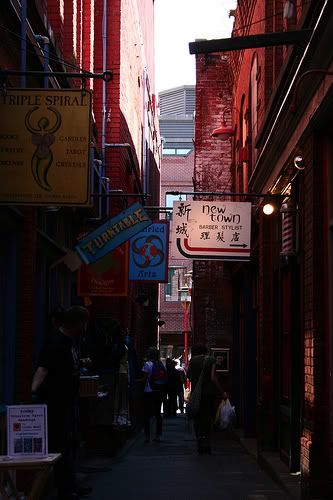 Above: Fan Tan Alley in Chinatown, Victoria.
Fan Tan Alley is known as being quite possibly the narrowest street in Canada. Its narrowest point measures 90 centimeters (just under 3 feet) wide. It used to be a hotbed for gambling and opium dens, but now houses tourist gift shops, some art galleries and boutiques. It's a pretty bizarre experience to find a mini-community inside a narrow alley between two old brick buildings, that's for sure.
The journey back on the ferry was quite turbulent. The waves were pretty punishing and I was feeling thankful I decided to delay dinner until I arrived on the mainland, because I would've certainly lost that dinner several times over.
Overall, it was an exhausting day (I was awake for 22 hours straight, because I needed to catch the early ferry there and ended up taking the last ferry back), but that's what trips to Victoria usually call for, in my case. Let's see how long it'll take for my body to catch up with the sleep it was begging for throughout that trip.
Subscribe to:
Posts (Atom)


 Posts
Posts