Sometimes, as English speakers, we take our ability to read and speak English completely for granted. We make fun of people for spelling it "alot" and people who type "should of." But after spending time in a country where the English proficiency level seems to be quite low, you start to realize that there are really times when we don't appreciate English's importance in the world.
When I was flying over to Seoul from Vancouver, I did a layover at Shanghai's Pudong International Airport. One of the main concerns prior to leaving was whether I'd be able to find my way around to ge to my connecting flight -- will my lack of (written) Chinese knowledge and Mandarin skills come to bite me in the ass? Will I miss my flight because I saw a sign that I thought said "International departures" but actually said "Turnips for sale"? Will I even understand any of the stuff coming from the plane's speakers during the flight?
Those fears turned out to be completely unfounded due to the intense power that English has.
At the airports, there were obviously signs written in the local language -- Chinese for Shanghai and Korean for Seoul. But those two places' signs also shared a common language. You guessed it, it was English. Not French. Not Spanish. Not Klingon. Not Newspeak. English.
On the flight from Shanghai to Seoul, I was wondering whether language was going to be a problem again. Again, those fears were unfounded -- the plane's announcements were in Mandarin Chinese, Korean and -- you guessed it -- English.
It was at that time (well, and after seeing that even North Korea's airport uses English despite being so outspoken against American "imperialists" in Korea) that I realized that if you have a working knowledge of English, you are more or less capable of navigating through almost every major airport in the world. That means your travel horizons have broadened a lot simply because you can read English.
Further evidence can be seen in Seoul. On the subways, the stop announcements will always be in Korean and English. Some stops also have Japanese and Mandarin Chinese announcements, but they will always have English.
Also, in the international district of Itaewon, guess what the common language is (besides Korean) for all the businesses, regardless of whether it's Turkish style, Indian style, or whatever nationality's style. That's right -- English. I got my cell phone set up at a Turkish dealer in Itaewon and the store had English and Korean signs, but no Turkish signs. In Itaewon, regardless of what nationality's flavors or stylings you're going for, Korean and English will always be spoken.
I think that speaks volumes about the power of English in a world where the United States is decreasing in importance and where China is stepping up. Despite this shift of power, even a place that's an hour out from China is still adopting English as the "international" language.
That leads me to my job as a native English teacher in Seoul. A lot of my students are very good at English and have an interest in studying it. There are also a lot who have no interest in English whatsoever and don't even try. I feel sorry for the latter because they're the ones who are going to be dazed and confused when they go traveling. They're the ones who will not get business opportunities abroad (regardless of whether the job is in an English-speaking country or not, especially for international firms). They're going to be more or less stuck in their little Korean cocoon and will not dare to venture outside the country even for a vacation, simply because the common international language out there is English. As far as I know, the only country where Korean is widely spoken across the people is, indeed, Korea.
Of course, part of that reason might be because there seems to be a mentality here that English is just a subject in school and nothing more. Let's compare Korea to a place like my birthplace, Hong Kong, where the English ability level is significantly higher. According to my dad, in the schools, they keep hammering home the idea that if you want to get any kind of decent job, English is a must. They tell you that if you don't know English, you're going to get a crappy job and won't get anywhere. Sure, they're a former British colony so this isn't all that surprising, but the fact is that English is also treated more than merely a letter grade or percentage on your report card.
In South Korea, this is definitely turning out to be a reality. The Chosun Ilbo is reporting what we all know -- in a country that handles international business like South Korea, knowing English will take you a long way. However, the general tone I got from that article is that the people surveyed weren't aware of this until they were out in the workforce and their lack of English ability bit them in the ass.
In a way, it isn't for lack of trying, because many places and chains here have English names and no Korean names. But simply naming places with English doesn't always result in language proficiency. Sure, many businesses (both Korean-owned and Western-owned) have English names, but once you see their marketing slogans -- when they're forced to string English words together rather than using them autonomously from one another -- you suddenly realize that South Korea has a long way to go because the slogan is often non-sensical or grammatically incorrect. You know your standards for Koreans using correct English have lowered when you don't wince at Lotteria's Borat-like "Happy Time!" slogan anymore.
It also doesn't help that English seems to be seen as a "foreigner's language" (rather than a business or world language), because of South Korea's anti-foreigner sentiment that seems to arise from time to time. There is a big "us vs. them" mentality in this country, so much so that Edward Said would go absolutely insane if he saw what was happening over here.
It's so often that we hear about people back home in Canada or the United States complaining about their local shopowner or neighbor not knowing how to speak perfect English. But after seeing a place like South Korea, I think we should really appreciate the fact that so many people back home can at least communicate in English, regardless of whether it's perfect English or not. We've taken English for granted for so long that we've forgotten just how much power English has, and how much power for a person can be limited if he or she does not speak English.
Saturday, October 31, 2009


Tuesday, October 20, 2009
South Korea Sights: Cheonggyecheon
 Above: Cheonggyecheon in its modern form, as seen from its starting point.
During the Japanese occupation, the colonial government intended to cover up the stream numerous times. After the Korean War, the stream attracted people who eventually made the side of the stream their home. The living conditions around it soon went downhill, and this drastically affected Seoul's image in a negative way. Along with the demands of rapid industrialization and modernization, the South Korean government decided to go through with what the Japanese colonial government wanted to do, and covered it up to make way for a highway in 1976.

Above: The giant cone (and water source) marking the starting point of Cheonggyecheon.
This came at an environmental price though -- because of what was done, the stream completely dried up and ceased to resemble anything like its original form. In 2003, the Seoul mayor at the time (and current president of South Korea) Lee Myung-bak announced plans to restore the stream. The plan was ambitious from the start, because the stream would have to be artificially re-created and the water pumped in (rather than relying on natural water sources). It also promised to drastically change the transportation infrastructure of the city.
The stream re-opened in 2005 and proved to be a dramatic success. The stream, which stretches for about 6 kilometers, also provides a greenbelt for pedestrians and is currently a popular tourist attraction.
Monday, October 19, 2009
Earthquakes can never prepare you for thunder and lightning
These past couple of weeks have been full of unstable weather here in Seoul. Every day, I would look out the window and try to predict whether it will be raining or not. At least back in Vancouver, you could tell -- if it's cloudy there, it'll likely remain cloudy for much of the day (or the week, for that matter). Here, it can change in an instant.
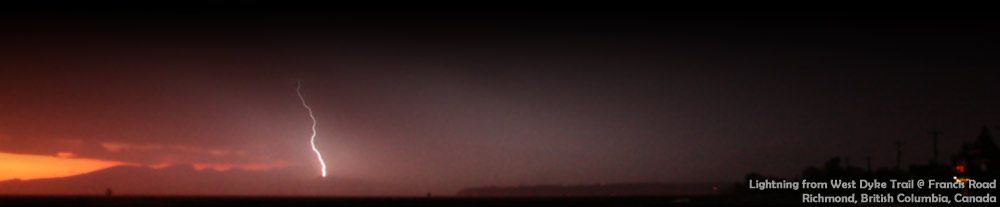
So imagine how I felt when I went to bed and it was still relatively clear, only to be awakened at around 3am by lightning and thunder. I stirred, looked around and went like, "Oh. It's thundering and lightning(ing?). Great." And then I buried my head back in the pillow again.
And then...
BOOOOOOOOOOOOM!!!
I've been through earthquakes before, but nothing could have prepared me for what happened. The whole room shook and the boom was deafening. I nearly fell out of bed in surprise. "What the bloody hell?" I thought. I had a tough time sleeping after that.
This morning, as I was brushing my teeth, I wondered if that boom and the shaking came from a direct lightning strike. I wonder if my poor little apartment was struck by lightning. The power was fine but even if there was a surge, the lights were off (obviously, since I was sleeping) so I couldn't tell anyway. But either my apartment got a direct hit, or a neighboring unit or building did (since my windows are about a foot away from the neighboring buildings).
Scary.
So imagine how I felt when I went to bed and it was still relatively clear, only to be awakened at around 3am by lightning and thunder. I stirred, looked around and went like, "Oh. It's thundering and lightning(ing?). Great." And then I buried my head back in the pillow again.
And then...
BOOOOOOOOOOOOM!!!
I've been through earthquakes before, but nothing could have prepared me for what happened. The whole room shook and the boom was deafening. I nearly fell out of bed in surprise. "What the bloody hell?" I thought. I had a tough time sleeping after that.
This morning, as I was brushing my teeth, I wondered if that boom and the shaking came from a direct lightning strike. I wonder if my poor little apartment was struck by lightning. The power was fine but even if there was a surge, the lights were off (obviously, since I was sleeping) so I couldn't tell anyway. But either my apartment got a direct hit, or a neighboring unit or building did (since my windows are about a foot away from the neighboring buildings).
Scary.
Friday, October 2, 2009
What happens in Korea stays in Korea...
After being in Korea for a little over a month, there are certain things that are guaranteed to happen. Here are some things that become a way life after a while.
- from your obscured view of Seoul Tower on your way to work, you can differentiate between mist, fog, smog and just plain airborne crap.
- you hear "T-Money" and don't instinctively think it's a name of a rapper.
- motorcycles nearly running you down on the sidewalk no longer faze you.
- you learn to ignore the people selling their homemade CDs on the subways.
- your local supermarket chain (Lotte Mart, E-Mart, etc.) has some of their employees dressed either in traditional Korean hanbok (한복, dress) or dressed like female anime characters. And then you see one of them on break at the food court... so imagine a tired-looking Sailor Moon at a food court slurping back some noodles.
- the local supermarket chain has greeters like Wal-Mart, but not only do they "bow" welcome to you, they also wipe down the push handle of your shopping cart on your way in.
- your neighborhood has crappy sanitation and power lines tangled all over the place above you as you go down the street, yet you consider the international district of Itaewon (이태원) to be much seedier and more of a slum.
- you see South Korean soldiers out on the streets in full garb on a daily basis.
- you can differentiate between the "good" and "bad/hooligan" US soldiers.
- you see more Dunkin' Donuts locations in Seoul than any major city on the west coast of the United States.
- every car you see is either a Hyundai, Kia, Renault/Samsung, Daewoo or Ssangyong. The other day, I saw a Ford and a Honda next to each other near Seoul Station, and nearly had a heart attack due to the surprise.
- you find out about Dokdo (독도).
- you know how to avoid discussing Dokdo.
- you know not to call Dokdo "Takeshima."
- you know how not to display any affection for Japan, regardless of whether you have any or not.
- you start thinking that 20 MB per second is a "slow internet connection."
- on your way to work, there'd be at least one convenience store.
- on your way to work, there'd be at least one hagwon (학원, private education academy).
- on your way to work, there'd be at least one PC bang (PC방, internet cafe).
- on your way to work, there'd be at least one "budongsan" (부동산, real estate office).
- you avoid looking inside the wastebasket next to toilets in the public washrooms. (Those in South Korea will know exactly why.)
- an address means diddly squat when you're actually on the streets trying to look for it.
- seeing two men on the streets with their arms wrapped around each other's shoulders doesn't draw any assumptions of homosexuality.
- being drunk in public is acceptable (and sometimes encouraged).
- you see cabinets full of gas masks on the platforms of subway stations.
- avoiding flying blobs of spit and phlegm while on the street becomes a life skill.
- the word "dong" (동, neighborhood) stops having sexual connotations, once you realize that you live in one.
- the subway train losing power between Seoul Station and Namyeong Station no longer alarms you.
- a phrase like "I'm not going to drive... I'm in a hurry, so I'll take public transit" makes perfect logical sense.
- you know that "b" is actually pronounced like "p," and "j" is actually pronounced like "ch," and "g" is actually pronounced like "k," and so on.
- when you order something from a Korean restaurant, you'll get more than what you order; in particular, you'll probably get kimchi and salad.
- being a millionaire is nothing to brag about, since 1 million KRW is only something like $940 CAD.
- you find out why there's a "Don't throw your key away" sign at the "love lock fence" at the foot of Seoul Tower.
- you know that takeout delivery will likely provide you with real (non-paper) plates and utensils, and you know what to do with them afterwards.
Subscribe to:
Comments (Atom)


 Posts
Posts